-
12/12/2024 Why you should consider a JCB Apprenticeship and how to apply
Dive into a JCB apprenticeship, where incredible opportunities await just like those Tilly Beene experienced!
-
12/12/2024 Reduced Tail Swing Excavators The JCB 145XR
In this video, Lucas Haddock showcases the JCB machines 145XR and its capabilities In the Kevin Quarry. As a new machine, Oliver Sands explains the new innovations and different applications it can be used for. From the Cab to the new X series engine, you’ll learn here how the JCB 145XR can be used to help you on site.
-
12/12/2024 Inside the JCB Factory 3D Control the Future of Digging
To find out more Peter Haddock took a walk around the heavy excavator facility in Uttoxeter with Assembly Manager Tom Whitaker.
During a recent visit to JCB, I spoke to Oliver Sands about the new 145XR reduced tail swing excavator. I also had a chat with Tilly Beene about what it’s like to be a part of the degree apprenticeship scheme at JCB.
After I saw the 145XR launched at the JCB press launch, I returned to the Kevin Quarry a week later for an in-depth look at the machine. This was my first experience with a JCB machine, so I was excited to be able to get my hands on the levers and operate. I really enjoyed operating the 145XR and was rather surprised by the size of the cab, especially since it is a reduced tail swing machine. I was very intrigued about this new machine and wanted to find out more.
I then spoke to Oliver Sands, the Excavator product specialist at JCB, and asked him to explain a few things about this new machine. He told me, ‘The 145XR is a reduced tail swing product that operates in the 14-16 ton sector, and usually, with these products, you will find that the cabs are shrunk in order to package everything together. ‘ But there was a clear difference in this machine, considering the cab was a regular size and didn’t seem to be shrunk at all.
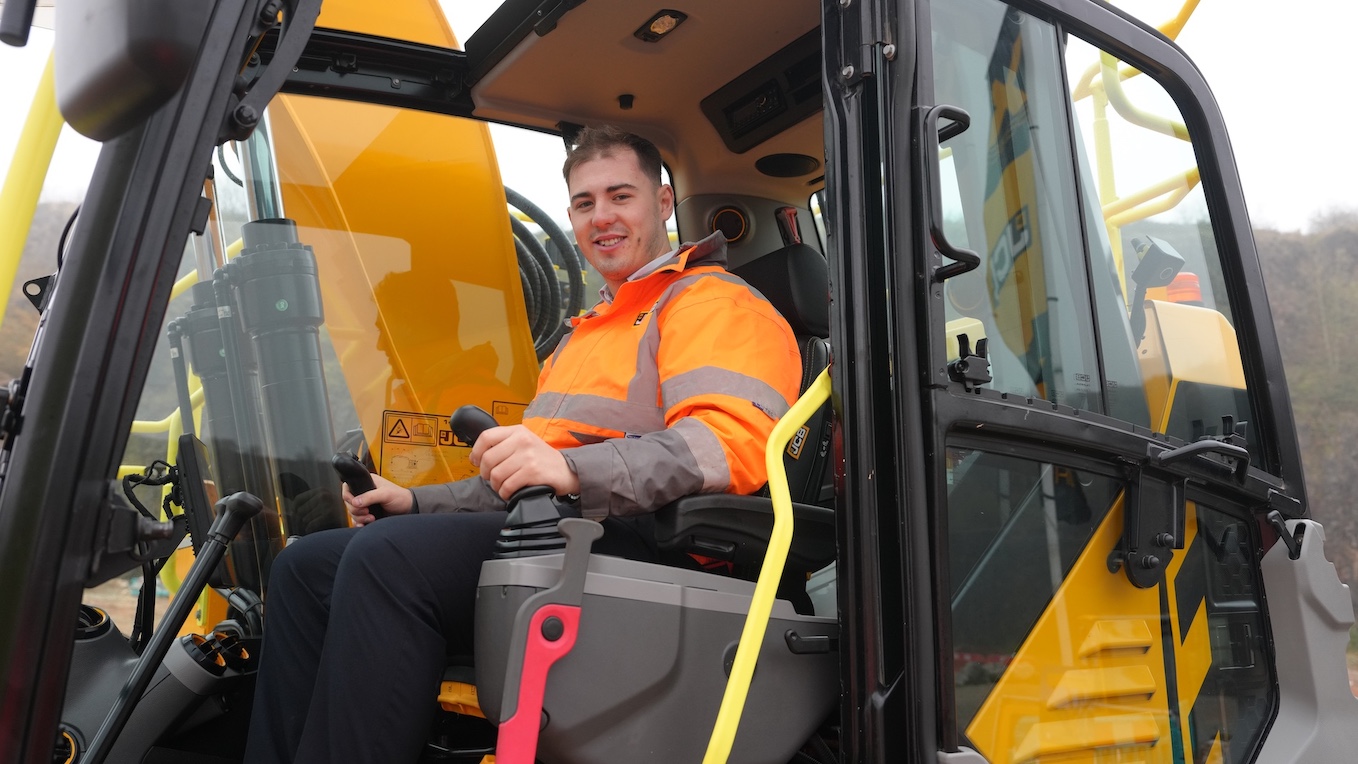
Oliver then explained, ‘It was a big part of our development process to ensure operators were not compromised when sitting in this cab because, as we know, they’re in it all day, every day.’ So, the 145XR was fitted with a full-sized X series cab, the same cab you would find on a 370X, their largest excavator in the range, to ensure comfort when operating for long hours.
The 145XR also came with a huge display, which is something I haven’t seen before on an excavator. This is the new UX 10-inch touchscreen display, which offers extensive customisation in terms of joysticks, hydraulic controls, and attachment features I found this rather interesting. However, one of the best features, in my opinion, is that the cameras are now integrated into the display.
I was also told, ‘This new machine is now a standard fit with a twin camera set-up, with one on the right-hand side and another on the rear.’ This is a good safety feature, as this machine would be operating in many compact areas. This excavator also offers a 360-degree camera option, which adds a third camera on the left-hand side and a fourth camera on the front of the cab. This would give you a fantastic birds-eye view.
The machine is also much safer in compact areas and house-building sites. Its all-around visibility makes it easier to see blind spots and prevents accidental damage to the machine.
Moving around the machine, I had a few questions for Oliver regarding the boom; as I heard in the press launch, a few variants were available. On the day the 145XR had a mono boom fitted, I was told, ‘From the new year, the machine will launch with a triple articulated boom and a 2.5 metre and a 2.73-metre dipper option.
This excavator is also fitted with high and low-flow pipe work. Many different hydraulic variants are available for this machine, including a hammer line, hammer auxiliary and a merge circuit. With the machine fitted with low flow, you can also get things like JCB’s advanced tool selection; this enables you to change the pressure and flow of the hydraulic system from within the cab.
With the high and low flow hydraulic system, these machines can also be fitted with 360 degree tilt rotators to help get the right angles when digging in tight spaces, which is a huge benefit. We then discussed the fitting of tilt rotators. Oliver explained how JCB tested this machine to ensure the attachments can be used: ' During the development process on this machine, we’ve spent the time fitting tilt rotators to ensure that they operate as intended, as we have the hydraulic capabilities to support those solutions.’
As we moved around the machine, I came onto the engine, which really spiked my interest because I recently saw that JCB created their millionth engine. We discussed the fuel savings on the new engines, as I had heard much about it at the initial press launch.
The 145XR uses the same engine as some of our existing range, including the 140 and the 150x. This being the JCB 448 engine, running at 81 kilowatts, with the engine having the same drivetrain components in terms of the hydraulic system.
They have increased fuel-saving by reducing the engine's running speed to make this machine even better for fuel saving. As for the outgoing model, the JZ 140, they have reduced the rpm from 2050 to 1700, which gives you up to 10% fuel consumption reduction, equivalent to a £2000 saving per year. So, in my opinion, that is a huge saving when buying a machine and really beneficial to buyers.
Upon looking at this machine's reduced tail swing, Oliver told me, ‘The tail swing is 17% shorter than our 140X, which is the conventional tail swing model, which means just over one and a half metres in tail swing altogether.’ This is very important when it comes to the application of the machine because we are seeing a massive increase in the demand for houses and a push on infrastructure where a machine like this would really thrive due to how compact it is and how easy it can fit into tight spaces.
This machine truly has some capability, with factory-fit Leica geosystems 3D machine control. With the use of Leica machine control and the ability to install a tilt rotator, this machine is very efficient because you can dig to the correct degrees and the correct depth. This would benefit the house-building sector due to the efficiency of the different technologies.
With Leica 3D machine control being launched earlier this year on the 220X, it is in the process of being launched on the 145XR; Oliver explained to me, ‘The reason it’s fantastic for house building applications is that the demand is going right the way up for house building and targets we’ve never seen before set by the government this year and can’t do it fast enough so we are going to want to be as accurate as possible so we’re not wasting time.’
We then moved around to look at the fans and different components inside the machine, talking about the other areas of the machine, including how compact and well-organised the fans are to ensure easy access to these areas, especially whilst trying to fit the counterweight in. Easy access inside the fan areas lets you clear debris as the machine fits with a fold-out condenser unit. One of the great advantages is that you can reach all of these components from the ground level.
This concluded my chat with Oliver Sands about the 145XR. I enjoyed using this machine, especially because it was my first time using a JCB machine. The 145XR was smooth and pretty cool, especially with the big screen inside, which I hadn’t seen before.
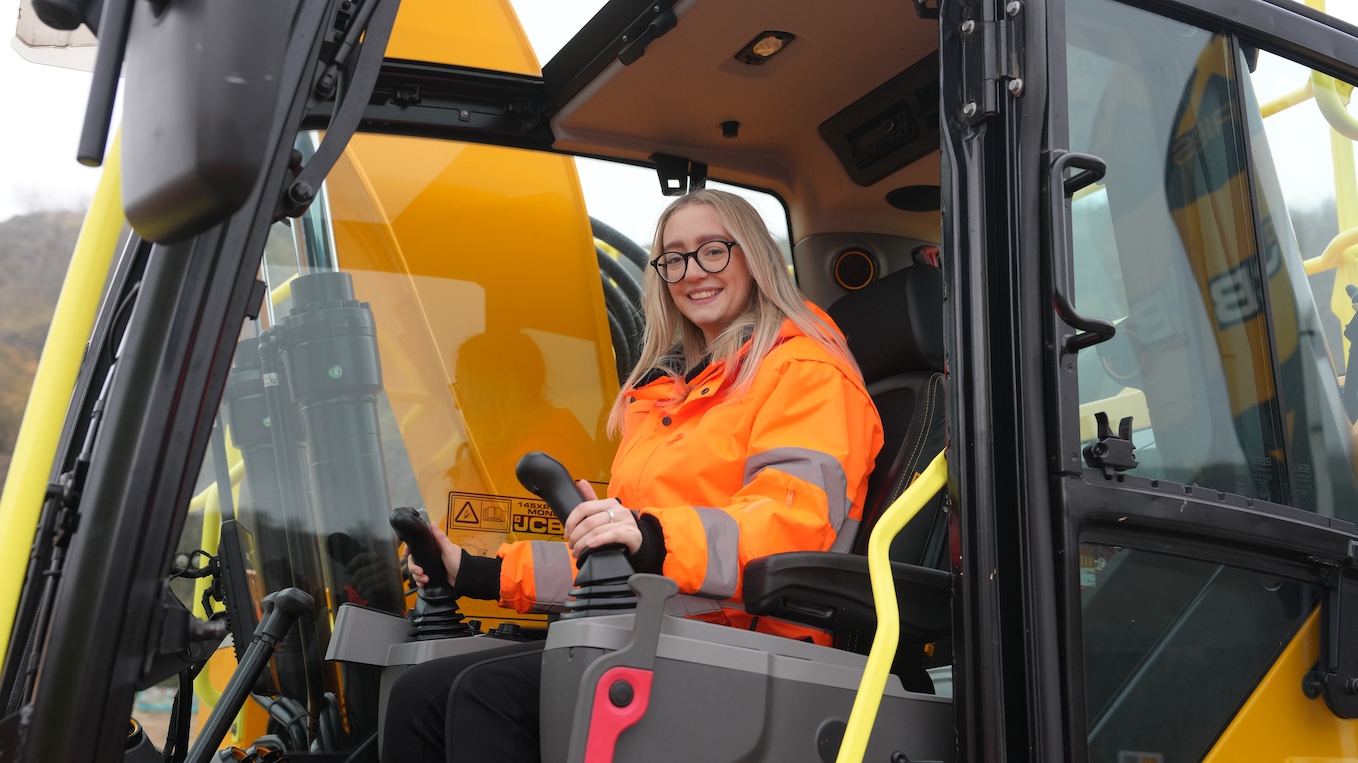
I also spoke to Tilly Beene, who is in her second year as a business degree apprentice at JCB. We had a very interesting conversation, and I was intrigued by how the apprenticeships work at JCB. Since I am an apprentice, it is a very good route, especially given the work experience you will gain.
Tilly told me she joined the apprenticeship scheme mainly because ‘I wasn’t keen on going to university full time; it wasn’t something that interested me.’ She also said she wanted to ‘Get into a business and learn how they work, see different departments, and get to grips with what it’s like in the working world.’ I completely agree because, in an apprenticeship, you can gain a lot of knowledge for a business and some key skills within a company.
We then discussed the advantages of a degree apprenticeship or university. Tilly said, ‘I think there are advantages to both. It depends on your interests and what you want to do in life.’ However, we both agreed that attending university involves much more debt than an apprenticeship.
With a degree apprenticeship, you can reflect your learning from university into your job role and implement it into your day-to-day role. Especially because during her time so far at JCB, Tilly has been through three different roles in the first two years of her apprenticeship, including marketing as her first placement, then onto setting up a new SAP system with a project team, and now she is in her third role which is a product in large excavators.
I also learned that you can move around many different roles in the UK and America within JCB. As you are given multiple roles, you will also gain a much better knowledge of other parts of the business by the time you finish your apprenticeship.
After speaking to Tilly and Oliver, I learnt a few things about the business, especially gaining more knowledge on the apprenticeship scheme that Oliver has completed and is currently working her way through. It was a real highlight to operate a JCB machine for the first time and talk to Tilly about her experience through the industry so far.


